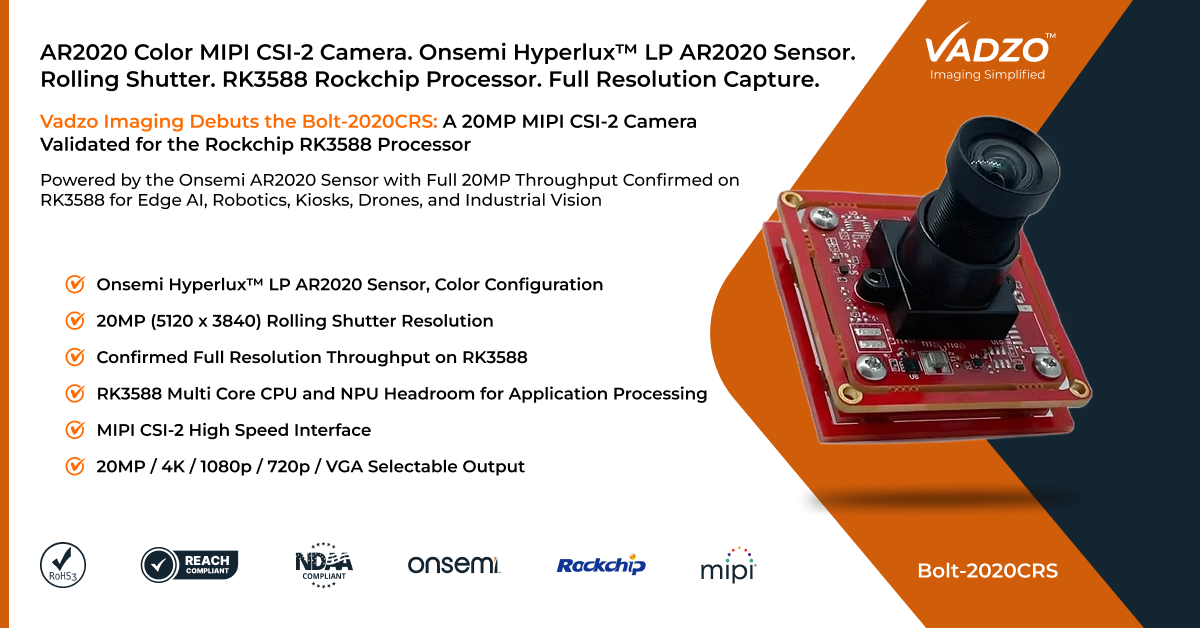
The Bolt-2020CRS is a 20MP Color MIPI camera based on the onsemi AR2020 sensor, validated with the Rockchip RK3588 processor for high-resolution imaging and embedded vision applications. The validated MIPI CSI-2 integration provides OEMs with a ready camera platform for RK3588-based robotics, edge AI, industrial vision, kiosks, and other high-performance embedded systems.
FORT WORTH, TX / ACCESS Newswire / September 21, 2026 / Vadzo Imaging, a provider of embedded vision camera products for OEMs and system integrators, today announces validation of the Bolt-2020CRS AR2020 Color MIPI CSI-2 Camera, a 20MP color rolling shutter camera built on the Onsemi AR2020 sensor and confirmed for direct integration with the Rockchip RK3588 processor. Part of Vadzo’s MIPI camera portfolio, the Bolt-2020CRS pairs the AR2020’s full 20MP pixel array with the RK3588’s high-bandwidth CSI-2 receiver and multi-core processing capacity, giving OEMs a camera platform that captures and processes true full-resolution frames rather than downscaling at the sensor level to fit a lower-capacity host. With this validation, Vadzo delivers a 20MP Color MIPI CSI-2 Camera that ships with confirmed device tree overlays and Linux driver packages for RK3588, giving robotics engineers, kiosk manufacturers, and edge AI developers a camera module ready for direct integration into high-resolution vision products without independent driver development.
Technical Problem Definition
A 20MP sensor is only as useful as the platform receiving its output, and this is where many embedded vision designs quietly fail before a single frame is captured. High-resolution sensors like the AR2020 exist specifically to give OEMs the option to capture a wide field of view at full detail and then crop or digitally zoom into any region of interest after capture, avoiding the mechanical complexity of a pan-tilt-zoom assembly or multiple lower-resolution camera units covering different zones. That option only exists if the host processor’s MIPI CSI-2 receiver, hardware ISP, and memory bandwidth can actually ingest and process a full 20MP frame at a usable frame rate. Many embedded processors marketed as camera-capable were designed around sensors in the 2MP to 8MP range, and pairing them with a 20MP sensor forces an OEM to either downscale the sensor’s output before it reaches the host, discarding the resolution advantage that justified choosing that sensor in the first place, or accept a frame rate so low the camera cannot support real-time operation. This problem compounds within the Rockchip ecosystem specifically, since Rockchip’s SoC lineup spans a wide range of camera subsystem capability, and a camera validated against a lower tier Rockchip module does not necessarily confirm that the same camera can deliver full resolution frames on a different Rockchip generation. Device tree node structure, CSI-2 bandwidth allocation, and ISP buffer sizing all vary enough between Rockchip SoC generations that a camera confirmed on a lower-tier module can still bottleneck or silently downscale on a higher-resolution sensor pairing, a failure mode that often only surfaces once an OEM has already committed to a board design around the assumption of full-resolution capture. OEMs choosing a 20MP sensor for a Rockchip-based product need to know not just that the camera is Rockchip compatible in a generic sense, but that the specific Rockchip SoC in their design can actually receive and process the full frame the sensor produces, a distinction that a generic MIPI CSI-2 compatibility claim does not address.
Engineering Explanation
The Bolt-2020CRS addresses this gap by validating the Onsemi AR2020 sensor’s complete 20MP output against the Rockchip RK3588 processor’s camera subsystem specifically, rather than a generic MIPI CSI-2 electrical specification. The RK3588 combines an eight-core big. LITTLE ARM CPU cluster, a neural processing unit rated near six trillion operations per second, and a hardware image signal processor built to handle substantially higher resolution and bandwidth than Rockchip’s lower-tier vision-focused SoCs. The AR2020 is a 20MP (5120 x 3840) color rolling shutter sensor with a 1/1.8 inch optical format and 1.4 micron pixel pitch, and Vadzo confirms the complete MIPI CSI-2 pad chain from the AR2020 sensor subdevice, through the RK3588’s CSI-2 receiver, into the hardware ISP pipeline, and out to the video device node at full 20MP resolution rather than a downscaled intermediate format. This makes the camera an RK3588 Multi Core Vision Sensor platform in practice, since the RK3588’s CPU and NPU headroom remain available for application processing even while the camera pipeline handles full resolution capture, rather than the host spending its entire processing budget just moving pixels off the sensor. A Rockchip Color Vision Sensor validated this way gives OEMs confidence that the 20MP figure on the datasheet reflects what the camera actually delivers in production, not a specification that only holds true in isolation from real application processing load. Vadzo supplies confirmed device tree overlays and Linux kernel driver packages specific to RK3588, covering the sensor node, the high-bandwidth CSI-2 endpoint configuration, and the ISP pipeline settings tuned for full resolution throughput, so integrators start from a validated reference configuration rather than deriving lane mapping and bandwidth parameters from a generic MIPI CSI-2 datasheet. As an RK3588 Rockchip MIPI CSI-2 Sensor Kit, the evaluation package lets engineering teams confirm full-resolution capture on their own RK3588 hardware before committing to a production design, and the same validated reference qualifies the camera as a genuine RK3588 High Res Camera Module rather than a bare sensor requiring independent bandwidth characterization. The camera supports selectable output modes from full 20MP down through 4K, 1080p, 720p, and VGA, letting OEMs balance resolution against frame rate and downstream processing load for their specific application, and the camera is rated across a -30 degree C to 70 degree C operating range suited to indoor and enclosed outdoor deployments. Vadzo validates this bandwidth claim under sustained capture conditions rather than a brief benchmark, since a camera that delivers full resolution for a few seconds before the pipeline drops frames or the ISP falls behind provides little practical value to an OEM building a product meant to run continuously.
Product Overview
The Bolt-2020CRS is an AR2020 Color MIPI CSI-2 Camera built on the Onsemi AR2020 sensor and validated specifically for the Rockchip RK3588 processor. As an Onsemi AR2020 Color Sensor, it is purpose-built for OEMs who need confirmed full-resolution capture rather than a generic Rockchip compatibility claim that leaves the actual bandwidth question unanswered. The AR2020 20MP Color MIPI Camera designation reflects Vadzo’s validation process, which confirms pad format negotiation, ISP tuning, and full 20MP throughput directly on RK3588 hardware before the module reaches OEM customers. The camera module houses the AR2020 sensor, ISP, and MIPI CSI-2 interface in a compact form factor with a standard M12 lens holder. Output modes include full 20MP, 4K, 1080p, 720p, and VGA, selectable to balance resolution against frame rate and CSI-2 bandwidth for the target workload. As an AR2020 Rockchip MIPI Camera, the camera integrates with the RK3588’s Linux camera stack through confirmed device tree overlays, requiring no proprietary vendor software package for basic frame capture or exposure control; the AR2020 RK3588 Rockchip MIPI Camera designation specifically confirms this integration path on RK3588 hardware.
Key specs: 20MP (5120 x 3840) | Onsemi Hyperlux™ LP AR2020 1/1.8 inch 1.4 micron pixel | Color | Rolling Shutter | Auto Exposure | RK3588 Rockchip Validated | MIPI CSI-2 | S Mount (M12 Standard) Lens | 20MP / 4K / 1080p / 720p / VGA |
Key Capabilities of the Onsemi AR2020 20MP RK3588 Rockchip MIPI Camera
20MP Color Resolution Validated for RK3588 Bandwidth: Many 20MP camera modules list a resolution figure that the host platform cannot actually sustain at a usable frame rate, leaving OEMs to discover the shortfall only after integration begins. The Bolt-2020CRS, positioned as a 20MP RK3588 Rockchip Color Camera, is validated to deliver its full 20MP (5120 x 3840) frame directly to the RK3588’s ISP pipeline at practical frame rates for still capture and periodic high-resolution analysis. This makes it a genuine 20MP RK3588 MIPI CSI-2 Sensor that OEMs can specify with confidence when the application specifically depends on full sensor resolution, such as wide-area monitoring where a region of interest is cropped digitally after capture rather than through a mechanical pan-tilt mechanism.
RK3588 Platform Validation for High Resolution Pipelines: A camera module that lists Rockchip compatibility in its datasheet has not necessarily been validated against the specific bandwidth and ISP configuration that RK3588’s camera subsystem requires for full resolution capture. The Bolt-2020CRS is validated specifically as a 20MP RK3588 Rockchip Processor Camera, with Vadzo confirming pad format negotiation, ISP tuning, and sustained full-resolution throughput directly on RK3588 hardware before release. This makes it a genuine RK3588 20MP Vision Sensor reference design rather than a generic MIPI sensor breakout board, giving OEMs a validated foundation for products that specifically require the RK3588’s higher camera subsystem capacity.
Multi-Core Processing Headroom for Full Resolution Capture: Ingesting and processing a full 20MP frame consumes more processing and memory bandwidth than a typical 2MP to 8MP sensor, and on a lower capacity SoC that overhead can leave little headroom for the application logic the camera was integrated to support in the first place. The RK3588 Rockchip Processor at the center of the Bolt-2020CRS validation provides enough CPU and ISP headroom that full resolution capture does not consume the entire processing budget, leaving cores and NPU capacity available for the OEM’s own application workload. This makes the camera a genuine Rockchip Color MIPI CSI-2 Camera choice for products where both full resolution capture and substantial on-device processing need to coexist on the same SoC rather than competing for the same limited resources.
Full Resolution Capture Without Sensor-Level Downscaling: The most common workaround for pairing a high-resolution sensor with a lower capacity host is to downscale the sensor’s output before it ever reaches the application, which defeats the purpose of choosing a 20MP sensor in the first place. Vadzo’s validation confirms that the Bolt-2020CRS delivers its full 20MP frame to the RK3588’s ISP pipeline without a mandatory downscale step, preserving the crop and digital zoom flexibility that a high-resolution sensor is meant to provide. OEMs specifying this camera can rely on the datasheet resolution figure representing what actually reaches their application, not a best-case number that assumes ideal conditions the host cannot sustain in practice.
Multi-Resolution Output for Archival and Real-Time Workflows: Selectable output resolution lets a single Bolt-2020CRS serve multiple roles within the same product. Full 20MP mode captures maximum spatial detail for archival imagery or high-resolution analysis tasks. The 4K mode balances resolution and bandwidth for high-quality live preview, while 1080p and 720p modes support higher frame rate operation for real-time inference or navigation tasks, and VGA mode suits lightweight presence detection ahead of a full resolution capture. As an AR2020 RK3588 Embedded Vision Camera, the camera lets OEMs design a single hardware platform that captures full-resolution reference frames while simultaneously running lower-resolution streams through the RK3588’s NPU for real-time analysis, rather than choosing one capability at the expense of the other.
OEM Integration Across Rockchip Programs: The Bolt-2020CRS ships with confirmed device tree overlays and Linux kernel driver packages for RK3588, and Vadzo extends the same validation discipline across its broader Rockchip camera lineup for OEMs whose product line spans multiple Rockchip generations. Available as an RK3588 Rockchip Camera Kit for evaluation, the camera lets engineering teams confirm full resolution performance on their own RK3588 hardware before committing to a production bill of materials. For OEMs evaluating Vadzo as an OEM RK3588 Color Module supplier, this means lens matching, firmware customization, and enclosure design support are available alongside the core camera hardware rather than as a separate engagement. Vadzo’s track record as an RK3588 Rockchip MIPI Camera Manufacturer covers production programs spanning multiple sensor families and interface types for OEM customers building high-resolution Rockchip-based vision products, and the MIPI Color Camera for RK3588 designation reflects Vadzo’s broader validation approach across the Rockchip camera subsystem rather than a single product.
“OEMs choosing a 20MP sensor almost always have a specific reason: they want to cover a wide area at full detail and crop into whatever matters after the fact. What we kept seeing was that reason getting undermined by the host platform, because the SoC simply could not move that much data through its camera pipeline without falling back to a downscaled frame. The Bolt-2020CRS was built to close that gap for RK3588 specifically. By validating the Onsemi AR2020’s full 20MP output against RK3588’s actual camera subsystem bandwidth, rather than a generic MIPI CSI-2 checkbox, we give OEMs confidence that the resolution figure on the datasheet is the resolution figure they will get in their finished product.” – Alwin Vincent, Product Manager, Vadzo Imaging.
Application Specific Sections
Edge AI Development Platforms: Engineering teams building a new high-resolution edge AI vision product on Rockchip silicon often start from a development board before committing to a custom carrier design, and the camera they prototype with needs to actually sustain full resolution capture on that hardware rather than only in a datasheet comparison. The Bolt-2020CRS works as an RK3588 Color Edge AI MIPI Camera for exactly this evaluation stage, connecting directly to standard RK3588 development board camera connectors with confirmed driver support, so engineering teams can validate full resolution throughput and image quality before finalizing a production design. Prototyping against confirmed reference hardware also shortens the debugging cycle when a design later moves from a development board to a custom carrier, since integrators already know the camera’s full resolution behavior is not the source of any new issue that surfaces during that transition.
Robotics and Autonomous Systems: Robotics platforms performing wide-area navigation or object identification benefit from a camera that captures enough native resolution to identify a distant object clearly and crop into it digitally, rather than relying on a lower resolution sensor that runs out of detail at range. The Bolt-2020CRS functions as an RK3588 Robotics MIPI Camera for these deployments, pairing full 20MP capture with the RK3588’s processing headroom so robotics integrators can run navigation and object detection algorithms directly on the camera’s host processor without a separate compute module handling the high-resolution stream.
Self-Service Kiosks and Interactive Displays: Self-service kiosks covering a wide interaction zone benefit from a single high-resolution camera that can identify and crop into a user’s face or presented document, rather than requiring multiple lower-resolution camera units to cover the same physical area. The Bolt-2020CRS serves as a Rockchip color Kiosk MIPI Camera for this role, giving kiosk manufacturers a single camera that covers a wide field of view at full detail while the RK3588 processes the relevant crop in real time for recognition or interaction logic.
Drone and Aerial Imaging Platforms: Aerial mapping and inspection payloads benefit directly from high-resolution capture, since more native detail per frame means fewer flight passes are needed to achieve the same ground coverage at a usable resolution. The Bolt-2020CRS operates as an RK3588 Rockchip Drone MIPI Camera for these platforms, giving drone OEMs full 20MP capture paired with the RK3588’s on-board processing capacity for real-time telemetry or preview generation during flight, without offloading that processing to a separate ground station.
Industrial Machine Vision and Inspection: Industrial inspection stations covering a wide field of view benefit from a camera resolution high enough to resolve fine defect detail across the entire frame rather than only in a narrowly cropped center region. The Bolt-2020CRS serves as an RK3588 Color Industrial Camera for these deployments, connecting directly over MIPI CSI-2 to the RK3588’s ISP and NPU so a single camera can cover a wider inspection area at full resolution than a lower megapixel sensor would allow, reducing the number of camera positions a production line requires to achieve full coverage. Quality engineers reviewing archived full-resolution frames can zoom into any region of a captured image after the fact, which supports root cause analysis on defects that were not the specific target of the inspection algorithm at capture time.
Frequently Asked Questions
Q: Why does Vadzo Imaging validate this camera specifically for the Rockchip RK3588 processor?
A: Vadzo Imaging designs its high-resolution camera lineup around a principle that a sensor’s megapixel figure only matters if the host platform can actually receive and process that much data. Vadzo Imaging validates full resolution throughput directly against RK3588’s camera subsystem bandwidth rather than relying on a generic Rockchip compatibility claim that leaves that question unanswered. Vadzo Imaging positions this validation as essential for OEMs who chose a high-resolution sensor for a specific reason and need confidence that reason still holds once the camera reaches production hardware.
Q: Does the RK3588 platform process the camera’s full resolution or does it downscale the image?
A: Vadzo Imaging confirms that the Bolt-2020CRS delivers its full native resolution to the RK3588’s image signal processor without a mandatory downscale step. Vadzo Imaging validates this specifically because many camera and host combinations quietly reduce resolution at the sensor level to fit a lower-bandwidth pipeline, which defeats the purpose of selecting a high-resolution sensor. Vadzo Imaging’s engineering process confirms the complete pad chain at full resolution before a camera module ships, and OEMs can verify this behavior directly on evaluation hardware rather than relying on a datasheet claim alone.
Q: Can Vadzo Imaging’s camera support both real-time AI inference and high-resolution recording at the same time?
A: Yes. Vadzo Imaging’s Rockchip camera lineup supports selectable output modes so a single camera module can deliver a full-resolution stream for archival or detailed analysis alongside a lower-resolution stream for real-time inference. Vadzo Imaging validates this multi-stream behavior specifically because many OEM products need both capabilities simultaneously rather than choosing one at the expense of the other.
Q: Does Vadzo Imaging provide driver and device tree support for RK3588 developer kits?
A: Yes. Vadzo Imaging supplies confirmed device tree overlays and Linux kernel driver packages for RK3588 alongside every camera module in this lineup, so engineering teams working from a developer kit can begin capturing full resolution frames without writing driver code from scratch. Vadzo Imaging maintains this driver support across the camera’s production lifecycle, which matters for OEMs planning a multiple-year product program built on the RK3588 platform.
Q: Why should OEMs building high-resolution Rockchip vision products choose Vadzo Imaging as their camera supplier?
A: Vadzo Imaging offers more than a camera that lists a high megapixel count on a spec sheet. OEMs building high-resolution Rockchip vision products and working with Vadzo Imaging receive a camera validated to actually deliver that resolution on their specific platform, along with engineering support covering lens selection, firmware customization, and enclosure design guidance. Vadzo Imaging maintains evaluation kits with no minimum order requirement, so engineering teams can confirm full resolution performance on their own RK3588 hardware before committing to volume production. This combination of validated bandwidth, confirmed driver support, and low minimum evaluation access is why Rockchip OEMs continue to choose Vadzo Imaging for high-resolution camera programs.
Availability
The Bolt-2020CRS AR2020 Color MIPI CSI-2 Camera built on the Onsemi AR2020 sensor is available now for evaluation and production orders. Evaluation kits include the camera module, MIPI CSI-2 flex cable, and RK3588 device tree and driver documentation, with no minimum order requirement. Engineering teams can confirm sustained full-resolution throughput directly on their own RK3588 hardware before committing to a production bill of materials, which matters more for this camera than a datasheet comparison alone could confirm. Browse the full AR2020 RK3588 Machine Vision Camera lineup at Vadzo’s website or contact Vadzo at support@vadzoimaging.com to request an evaluation unit or discuss OEM integration requirements for edge AI, robotics, kiosk, and industrial camera programs.
About Vadzo Imaging
Vadzo Imaging is a global provider of embedded vision solutions and delivers high-performance camera technologies and imaging platforms for applications in robotics, industrial automation, UAVs, edge AI, and medical systems. Its products are designed for seamless integration with leading embedded platforms including NVIDIA Jetson, Raspberry Pi, Rockchip, and NXP i.MX. Vadzo supports customers through hardware customization, firmware development, and module-level drivers, enabling faster development and deployment of vision-based systems across MIPI, USB, GigE, Wi-Fi, and SerDes camera interfaces.
Media Contact
Alwin Vincent
Vadzo Imaging
Email: alwin@vadzoimaging.com
LinkedIn: Vadzo Imaging
YouTube: Vadzo Imaging
X: Vadzo Imaging
SOURCE: Vadzo Imaging
View the original press release on ACCESS Newswire
Media gallery