
Major update opens large saved AI work 47% faster, cuts interface memory by 56%, speeds streamed response rendering by 48.6%, and quiets inactive sessions.
San Francisco, CA (PRUnderground) November 5th, 2026
Pervaziv AI today announced Cortex Discover 1.6, a major performance update to its dedicated agentic AI browser that focuses on a challenge becoming increasingly important as AI moves from occasional assistance into everyday work: what happens when the AI workspace itself becomes large?
Earlier Cortex Discover releases concentrated on a foundational question. Could an agentic browser add integrated intelligence while preserving the speed, responsiveness and resource discipline users expect from the browser itself?
The company’s October performance work showed that Cortex Discover could remain competitive with conventional browser performance during sustained AI use. Discover 1.5 then extended that work with faster startup, responsive interaction and near memory parity in controlled browser workloads.
Cortex Discover 1.6 moves beyond that baseline.
The new release focuses on the growing weight inside persistent AI experiences themselves: substantial saved conversations, richer histories, file and page context, repeated return to prior work, continuous streamed responses and sessions that remain available while the user’s attention moves elsewhere.
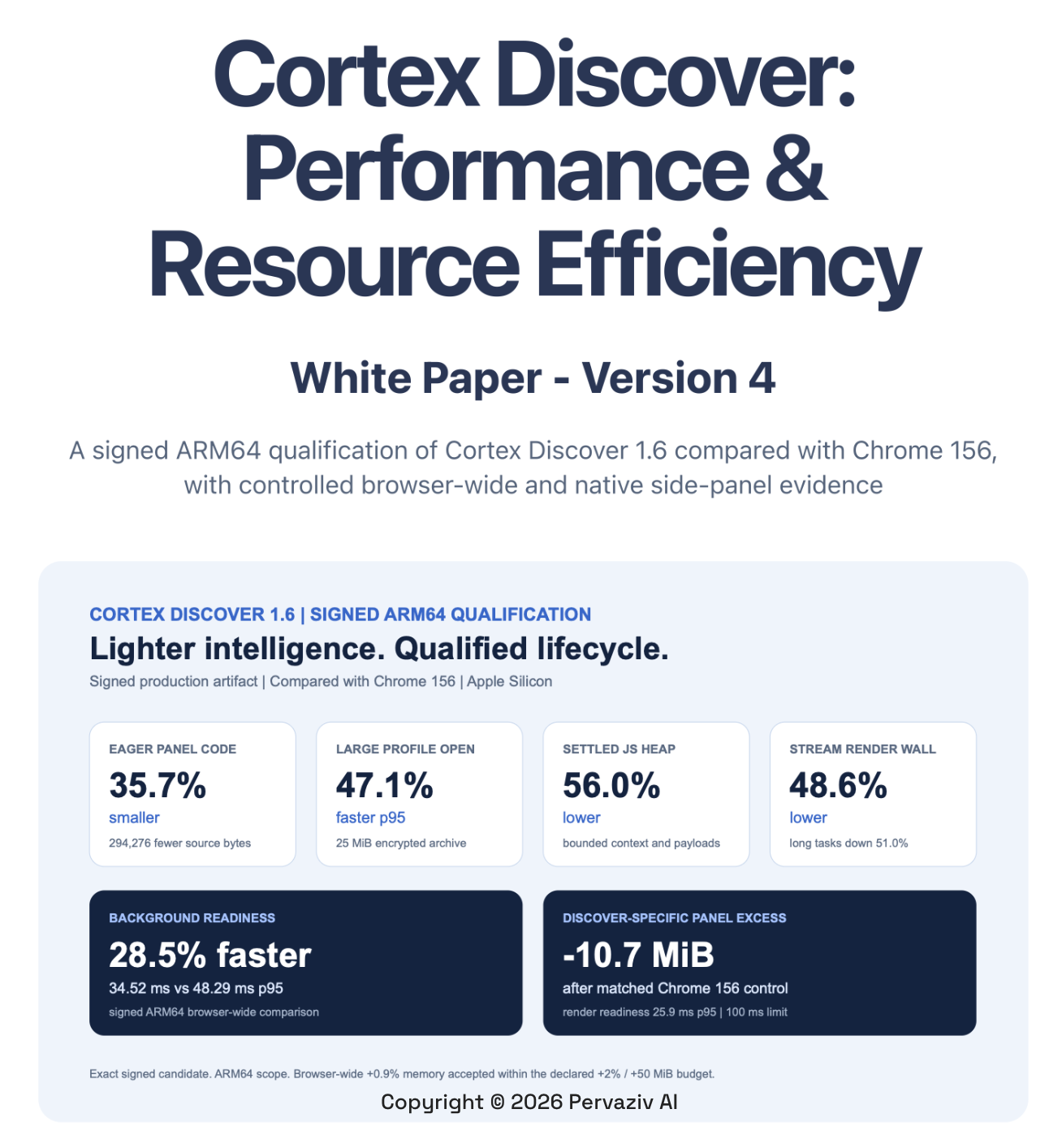
In controlled qualification, Cortex Discover 1.6 opened a large saved workspace 47.1% faster. Settled AI interface memory fell by 56.0%. A streamed response rendering workload completed 48.6% faster. Temporary active data remaining after the tested workflow fell by 99.2%, while inactive session activity was reduced by 90.0%.
The measurements are scoped to defined workloads and test conditions, not universal claims across every machine or browsing pattern. Together, however, they show the direction behind Discover 1.6: persistent AI should become more useful as the work grows without allowing the user experience to become progressively heavier.
Persistent AI, Without Persistent Overhead
The first generation of browser AI often treated each interaction as a short event. Ask a question. Receive an answer. Move on.
Agentic work is different.
A developer may research an issue, compare documentation, inspect a repository, review previous findings and return to the same investigation later. A security professional may move between evidence, analysis and remediation over an extended period. A researcher may build a substantial body of context across multiple sources before reaching a useful conclusion.
In these workflows, continuity is not a convenience. It is part of the value.
But continuity introduces a new performance problem. If every saved interaction, prior state and completed operation remains equally active, the workspace can become slower precisely because it has become more useful.
Discover 1.6 is designed to change that relationship.
The release keeps durable work available while reducing the amount of active weight required to resume and continue it. The goal is not to erase history or shorten the work. It is to make a large AI workspace behave more like a useful workspace and less like an ever growing performance tax.
“Persistent AI should become more useful as the work grows, not progressively heavier,” said Anoop Jaishankar, Founder and CEO of Pervaziv AI. “Discover 1.6 is about making long running intelligence feel lighter, faster and ready to resume, while keeping the browser experience users already expect.”
Large Work Should Not Mean a Long Return
One of the clearest improvements in Cortex Discover 1.6 is how quickly substantial saved work becomes usable again.
In the qualified large workspace workload, opening time at the 95th percentile improved by 47.1%.
That matters because the value of persistent AI is often realized when users come back.
Research rarely finishes in one sitting. Technical investigations can span hours or days. Security reviews may require a return to earlier evidence. Enterprise users often move between browser applications, documents, dashboards and conversations before completing a task.
If returning to prior work becomes increasingly expensive as history grows, persistence becomes a liability.
Discover 1.6 is designed so substantial prior work can remain available without forcing the active experience to carry the full cost of everything that came before it.
For users, the benefit is simple: less waiting before meaningful work resumes.
A Lighter AI Surface After the Work Is Done
Performance is not only about how quickly something appears. It is also about what remains after the interaction has finished.
Long running AI interfaces manage far more than visible text. They may hold information associated with active context, attachments, responses and ongoing workflow state. Some of that information is needed while a task is active. It should not all remain equally active after the work has moved on.
In the Discover 1.6 qualification workload, settled AI interface memory fell by 56.0%. Temporary active data remaining after the tested workflow fell by 99.2%.
Those measurements do not suggest that meaningful AI work requires no resources. Working with pages, files and substantial context naturally uses compute and memory while the task is active.
The improvement is about what happens afterward.
Discover 1.6 is designed to leave a smaller active footprint once work has settled, helping make longer running sessions more predictable for people who keep the browser open throughout the day.
That distinction is increasingly important as AI becomes a persistent work surface rather than an occasional tool.
Streaming Gets Faster Where Users Can Feel It
Streaming is one of the most visible parts of an AI experience. Users watch an answer develop while the interface continues to accept input, preserve context and prepare the completed result.
A fast model alone does not guarantee a fast experience.
If the client repeatedly performs unnecessary work as the response grows, the interface can become less responsive even when the underlying AI is generating quickly.
Cortex Discover 1.6 reduced wall time in the qualified streamed response rendering workload by 48.6%. Time spent in long running interface tasks fell by 51.0%.
The practical goal is not a faster visual effect. It is a more responsive workspace while substantial answers are being assembled, especially when they appear inside conversations that already contain meaningful history.
For an agentic browser, that matters because the AI surface and the browser surface are used together. Users may continue reading, navigating, comparing information or preparing the next step while an answer develops.
Discover 1.6 makes that interaction lighter.
Ready When Needed. Quieter When Not.
Persistent intelligence should remain available without behaving as though every open conversation is active work.
Cortex Discover 1.6 reduced inactive session activity by 90.0% in the qualification workload.
That improvement reflects a practical expectation for an AI browser. A user may leave an AI workspace open while reading documentation, reviewing a dashboard, working in another tab or simply considering the next step. The system should be ready to continue when attention returns without creating unnecessary background activity while the user is elsewhere.
Discover 1.6 makes that waiting state more disciplined while preserving the continuity users expect from an agentic workspace.
The shift is important because persistent AI is not only about doing more. It is also about knowing when not to do more.
The Browser Is Still the Guardrail
The largest Discover 1.6 improvements are deliberately focused inside the AI workspace.
This release is not positioned as another browser benchmark headline.
Instead, Pervaziv AI used browser wide performance as a guardrail to make sure that making persistent AI lighter did not compromise the surrounding browsing experience.
In a controlled comparison with Chrome 156 on Apple Silicon, Cortex Discover warm launch measured 3.2% faster and active CPU measured 5.8% lower in the tested workload. Background readiness was 28.5% faster at the measured 95th percentile. Both browsers maintained 60 FPS rendering, completed the workload at throughput parity and finished the video workload with zero dropped frames.
Browser wide active memory for Cortex Discover measured 0.9% above the Chrome 156 control, remaining inside the company’s declared 2% practical equivalence budget. Pervaziv AI treats that result as near parity rather than a memory improvement.
That framing is intentional.
The headline is not that Discover wins every browser metric. The headline is that the AI experience can become substantially lighter as work grows while the browser around it remains within its performance budget.
Tested Beyond a Single Demo
Persistent software also has to hold up after the first interaction.
The signed Cortex Discover 1.6 candidate completed nine measured ten minute sessions across different AI panel conditions and repeated native usage cycles after warm up runs.
All nine measured sessions completed. The campaign recorded zero workload errors, zero sampling errors, 903 of 903 healthy cycle samples and zero retained process growth. Render readiness measured 25.9 milliseconds at the 95th percentile against a 100 millisecond limit, and no additional network transfer was observed after the workload settled.
The testing was performed natively on Apple Silicon under the defined controls and workloads. The results apply to that signed candidate and test environment rather than every possible device, operating system or user workload.
Pervaziv AI considers that scope part of responsible performance reporting. Favorable numbers are useful only when the conditions behind them remain clear.
From Staying Fast to Scaling the Workspace
The Cortex Discover performance program has evolved in stages.
The initial work established that an agentic browser could compete on conventional browser fundamentals while adding integrated intelligence. Later sustained testing examined whether that behavior held as the AI remained active over time. Discover 1.5 continued improving startup and resource efficiency.
Discover 1.6 addresses the next challenge.
What happens when users actually keep the work?
When conversations grow, saved workspaces become substantial, context becomes richer and streamed interaction becomes routine, the AI surface itself becomes a performance domain.
That is the problem this release is built around.
The result is a different kind of performance story. Not merely faster launch. Not merely lower CPU. Not merely another comparison against a conventional browser.
It is about making persistence practical.
Large work resumes faster. Completed work leaves less active weight. Streaming requires less interface work. Inactive sessions become quieter. The surrounding browser remains within its declared performance boundaries.
Together, those gains move Cortex Discover closer to the broader Pervaziv AI vision for enterprise AI: intelligence that stays connected to the work without forcing users to trade away responsiveness, resource discipline or control.
More History. Less Weight.
Cortex Discover was introduced as an agentic AI browser designed to bring Cortex directly into web based work with live page context, multi tab reasoning, visual understanding, controlled browser action and continuity across workflows.
Discover 1.6 strengthens the performance foundation underneath that experience.
As AI becomes more persistent, the next performance challenge is not only how quickly intelligence responds. It is how gracefully the product carries the accumulated work around that intelligence.
Cortex Discover 1.6 is designed for that next stage.
More history without proportional overhead. Faster return to substantial work. Lighter settled AI sessions. Faster streamed interaction. Quieter background availability.
The principle is straightforward: intelligence should stay close to the work without taking over the machine.
Cortex Discover 1.6. Lighter persistent AI. Faster return to meaningful work. Performance designed to hold as the workspace grows.
Explore the Whitepapers
The original Cortex Discover performance whitepaper is available at https://pervaziv.com/white-papers/, with the updated report to be published there as well. Readers may also contact Pervaziv AI to request the complete versions of all whitepapers.


